Showing posts with label Garmin. Show all posts

March 29, 2010

Garmin, Suunto, Polar and Timex new gadgets and updates

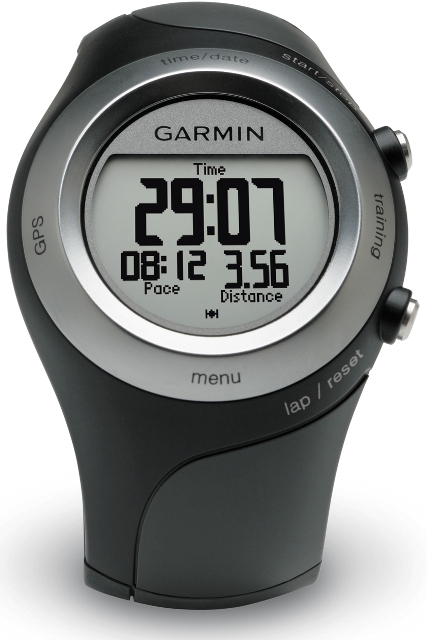
Garmin110.jpgLooks like GPS is becoming more pervasive in fitness watches - Garmin today announced new running watch Garmin Forerunner 110 that will bring GPS to what seems like more basic watch than FR205, FR305, FR405 and FR310xt. Main theme seems to be simplicity with high level of accuracy. They will be showing the units at the major marathons in Boston, Paris and London so the watch seems to be geared to runners, walkers and joggers. For triathletes it seems that the 310xt remains the flagship.


timexironmanglobaltrainer_lg.jpgTriathletes are probably looking forwards to the release of the new Timex unit that is the first version of Timex watch with built in GPS. They already have experience with GPS technology, but never had it integrated in the watch. We will see how well this will be done. From available information the unit will be ANT+ compatible so if you have ANT+ compatible power meter or HR belt the watch should be able to communicate with them.


Polar is releasing new sleek cycling computer CS500 that is based on their proprietary W.I.N.D. technology used in CS600 and RS800/RS800cx lines of products. The design looks very clever for cycling - I hate switching displays on CS600 especially when I wear my gloves and I'm in traffic. The rocker design seems to make it all very easy. Not sure though if I upgrade. The announcement on Polar site does not list power meter as one of the compatible accessories which is a shame. I hope it will work with it since I'm getting another Polar power unit I found few days ago so I can put it on my new road bike.


SuuntoBlackFlame.pngAnd last news is from Suunto that is releasing new designs of T6 line with release of three new color schemes and different packaging under the T6d name. According to their announcement the new units will ship in few weeks and will include the dual belt, but otherwise seem to be exactly the same as T6c. The new designs are Black Flame - black yellow (pictured), Black Smoke (Black and gray) and Black Fusion (Fusion with black housing - as opposed to the greenish one that currently ships). So unless you die to spend over 400 bucks for different design of the watch there is really not much new in terms of technology or functionality. Still the units look very good.

February 20, 2009

Mac support for Garmin Forerunner 50 and 405 released

Yesterday I received announcement from Garmin that the Forerunner 50 and 405 are now supported on Mac. Little later during the day there was a post on Garmin Blogs that explains little more about the level of support in this first release. As you may suspect there are some limitations. The current version supports upload of the workout results to Garmin Connect site. But it does not yet support updates of firmware from the PC to the watch and does not allow uploads of courses from computer to the watch. So the Mac support is there, but compared to PC users the 405 owners with Mac will still lack some critical features. The Forerunner 50 users will be happy with this release as the 50 does not have firmware updates or courses. Here is copy of the official announcement I received earlier:


Forerunner® 405 is now Mac-compatible

If you're a Forerunner 405 owner with a Mac, you'll be glad to know they are now in sync and you can transfer your workout data from the 405 to your Mac. The data transfer happens automatically via the wireless USB ANT Stick™.

Before the USB ANT Stick can start talking to your Mac, you'll need to download new software. Visit our "getting started" pages for the Forerunner 405, which will step you through the process.

Once you've completed the setup, your workout data will automatically transfer to your Mac and to Garmin Connect. On this site, you can store, analyze and share workouts with a community of fitness enthusiasts.

February 3, 2009

Few new HRMs from Garmin, Polar and Timex

This is just a quick post about some new HRMs that either already hit the market or will be released in upcoming weeks. There are some exciting new HRMs in the line-up of manufacturers that will make the 2009 season pretty interesting.


Garmin - leaving the GPS out


Let's start with the recently announced line of Garmin HRMs that are not sporting GPS capability. The FR60 that will come in mens and women version is HRM with ability to connect with ANT+ heart rate belt, foot pod, bike pod and cadence pod from Garmin. The watch will have standard set of features including ability to record up to 15 hours worth of workouts and capture 100 laps. Just like the Forerunner 405 this watch will connect wirelessly to your computer and transfer data to Garmin Connect site. According to the materials available on Garmin Blogs and Garmin site the watch will not support Training Center and programmed guided workouts. The watch should hit the market in Q2 of this year.


Polar - pushing the GPS to cycling

Polar just yesterday announced release of the CS600x cycling computer which is an enhancement of the flagship CS600 cycling computer. The CS600x integrates with the G3 GPS unit and captures the location information just like the RS800cx unit that was released late last year (and extensively reviewed on this site). The unit is sold in two packages - one with power and one without. It is very same packaging as with the CS600. None of the packages comes with the G3 sensor, but you can get the G3 sensor as an accessory. Other difference that I noticed from the comparison tool on Polar USA site is that the CS600x comes with the IR USB stick (just as the RS800cx). There are probably other differences, but they are not immediately apparent from the product description and feature list. Also I expect that Polar may make minor adjustments to the information on their website just as they did after the release of RS800cx.


Timex - focusing on the basics

Another addition to HRM line comes from Timex. The Timex Race Trainer Kit provides a good starting level HR monitor with ability to transfer data to ad from the computer wirelessly. What is interesting on this product is the fact that you are not only buying the watch, but also the access to the Timex Ironman online training site that is build on top of the Training Peaks engine. The watch integrates with the training site and according to the information available on Timex site there is ability to download workout data from the site to the watch and send the workout results to the site. Sounds like an interesting HRM for focused training. The training plans are designed by Dave Scott and Gale Bernhardt two large names in the triathlon world. You can find more details about this package on Timex site. Unfortunately I can not provide any more details on how well this package works as I have not used the watch or the Timex site yet.

December 19, 2008

TrainingPeaks now support mapping for Polar RS800CX

I wanted to blog this few weeks ago when the development team of WKO+ and TrainingPeaks contacted me if I would test some RS800CX related functionality for them. But back then I promised to keep my mouth shut until they had a final version of the WKO+ and announcement ready. Oh well then there was the marathon in Philly, lots of work in the office and all of a sudden we are few weeks later and I'm only getting to this.

It was more of a coincidence as I raised a support ticker with the Peaksware about the ability to import location data from RS800cx to WKO+ and TrainingPeaks. I wanted to use the functions they provide for any GPS logs like fixing the elevation data. I was pleasantly surprised when the development team contacted me few days later and provided early version of the WKO+ that supported the direct load from RS800cx to the WKO+. I did some test runs and loaded them to the TrainingPeaks and it all looked good. My only reservation is that the resulting log when loaded to the website shows only location information with no details about lap times, lap location, etc that you can get from PPT5 and GoogleEarth. So the result is not as useful for log analysis as what the PPT5 or WKO+ offer, on the other hand TrainingPeaks has ability to share workouts with others via e-mail or Facebook. So if you use WKO+ and TrainingPeaks you get best of both worlds - analysis of individual laps and ability to share workouts with others. With this functionality in TrainingPeaks you can easily link to your workout or race record from Facebook or send the log to your friends via e-mail.

Don't get me wrong I like the TrainingPeaks log viewer as it provides quite a lot of data for everyone to look at - practically all data your HRM can capture and if you want to re-live the entire 4 hours of your marathon experience (or whatever event you did) you can chose to view it as a replay at the same speed as it was recorded (or speed it up if you do not have 4 hours to watch...). I just wish it also showed lap times and added lap location to the map - perhaps in the next update (I hope Peaksware team reads this)..

I have captured recent race with RS800cx and loaded it to the TrainingPeaks. Click on the picture below to view the TrainingPeaks log if you want to see how the log file looks once it is loaded to TrainingPeaks. You can play around with it,no worries I will not see what you did and you can not mess-up the workout log. It is only a viewer after all.


TP-log.jpg

If you wondered about what Polar offers - well currently there is no support for location info on the Polar Personal Trainer site. The only HRM company that I know provides similar service at no cost to users is Garmin with their Garmin Connect site. I used the site when I had Garmin 405 and did not find it very useful beyond sharing the workout data with friends. I much prefer the combination of training planning / logging site with ability to share info than site that is built to share data only. But the Garmin Connect site is quite nice and many users find it sufficient for their needs. I only hope they already fixed the bug with average speed/pace that only took the last lap into account so your tempo workout showed overall average pace that was equal to the last lap pace. Perhaps Polar will introduce mapping and sharing capability over time as they seem to be re-working the site quite a bit. But I don't really know if I would use it since I'm already loading my data for my coach to TrainingPeaks...


October 3, 2008

Polar RS800CX field test - compared with Garmin Forerunner 405 output

I have been silent over the past few days, but that is only because the body needed well deserved rest and recovery time. Over the past few days I was pretty much sitting around and resting my leg. It got swollen on Monday and Tuesday around the ankle so I gave it enough rest before putting any stress on it. The swelling went down on Wednesday so yesterday I did first short bike ride on the trainer and in the evening went out for a walk with my son. I took the RS800CX with me for the walk with the G3 sensor to see how it performs. I also had the S3 sensor in my shoe, but it for some reason did not activate so I'll need to take it with me next time we go for a walk.


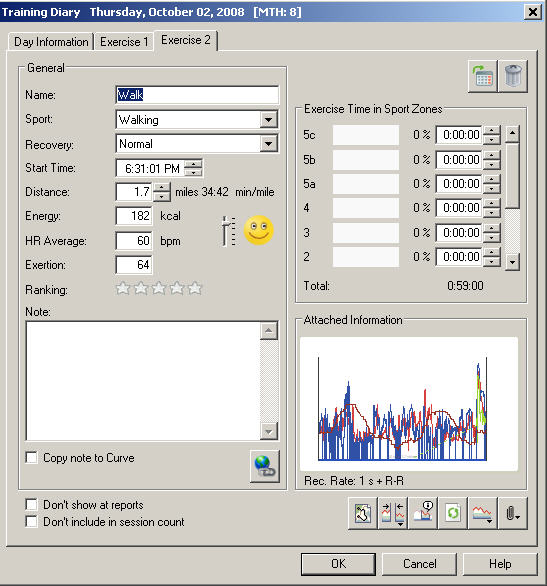
As we walked I took few laps to see how they show in the Google Earth and how the whole thing is implemented in the PPT5. Here are few pictures of how the walk turned out.


The first picture shows the exercise - yeah it was a very slow walk. I did not want to put stress on the leg and also walking with three years old involves few stops to check out various things - like a leave, manhole covers, trees, dog, car, house, and many other things. It is also like walking with Spanish inquisition... You with kids understand what I'm talking about.


RS800CX PPT5a.jpg

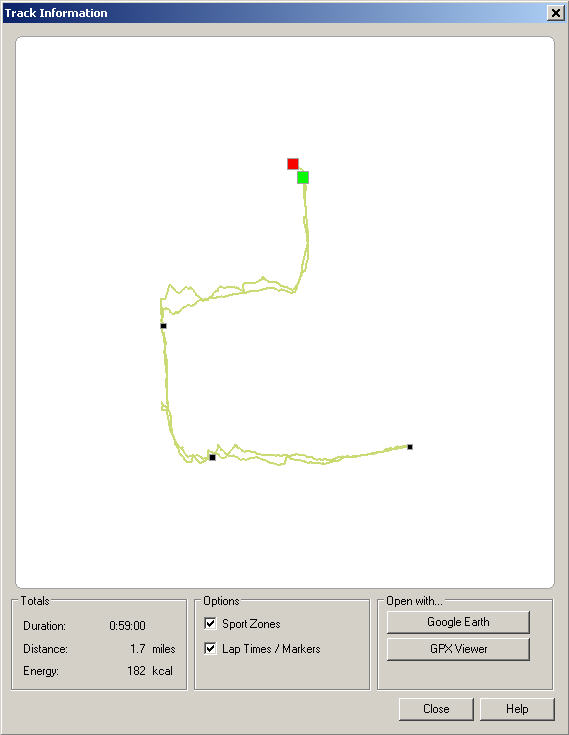
The second picture shows the PPT5 window with the location information - not yet overlaid over a map (like Garmin does in the Training Center), but ready for export to GoogleEarth or GPX viewer. Since I have only GoogleEarth I tried that option.


RS800CX PPT5b.jpg

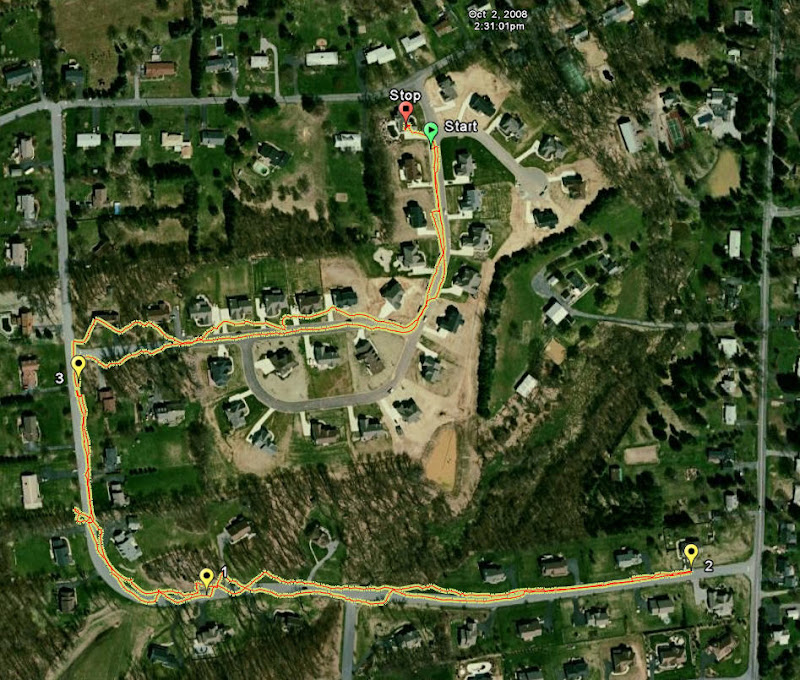
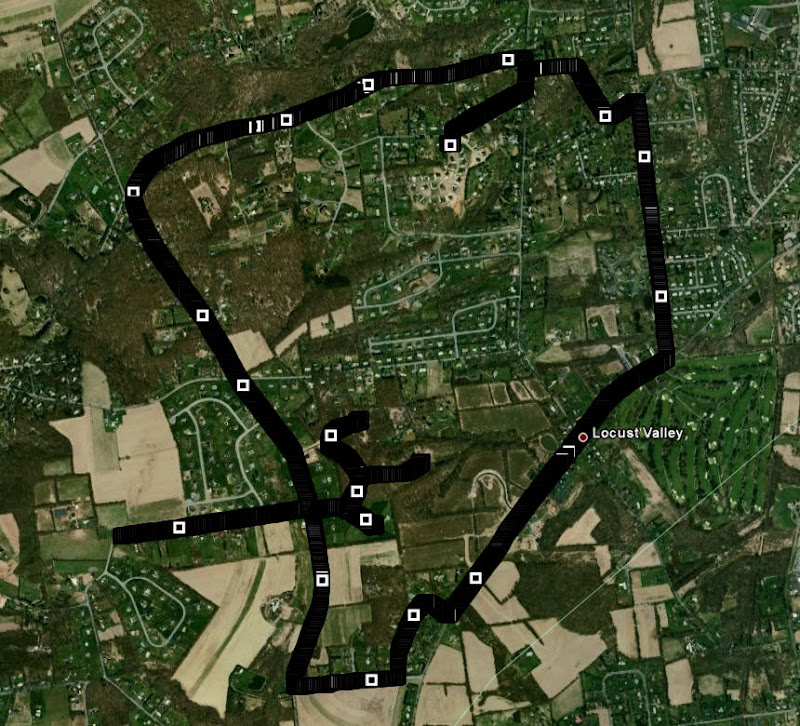
On this picture you can see the GoogleEarth depiction of the walk. Contrary to the path shown we did not walk on other people lawns, but walked on the road. The section close to lap3 where we are shown to walk on the lawn in both directions has pretty good tree cover which can explain the error. But I did not walk in straight line, but instead walked back and forth as my son drove his bike next to me.


RS800CX walk.jpg

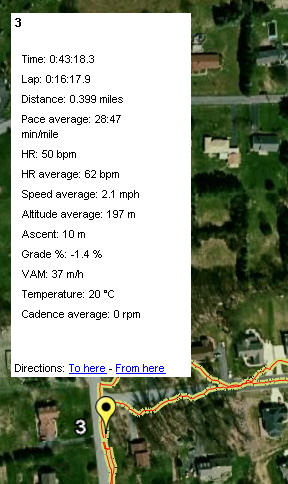
Third picture shows the lap information that is shown in the GoogleEarth. Pretty good information that get into GoogleEarth that helps analyze the segments much better than plain analysis in the PPT5 (which is still available, this is just an additional set of features Polar added to RS800CX).


RS800CX lap.jpg

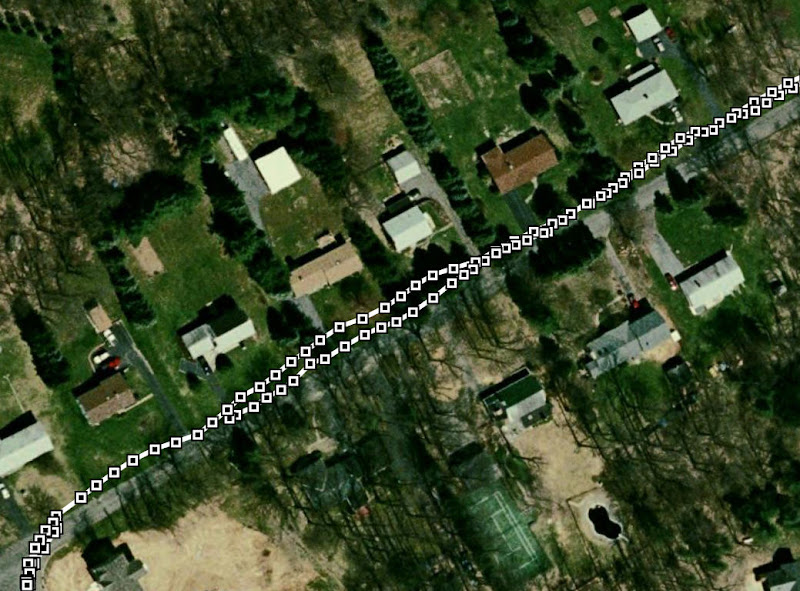
This picture is not from Polar, but from Garmin Forerunner 405 from one older run in the same area (longer than what we walked). And it is here just for comparison purposes. You can see that Garmin captures each coordinate and depicts it as a square so it appears to stay on the road.


Garmin FR405 run.jpg

But zoom in and you will see that even with Garmin the GoogleEarth shows you running on the lawn next to the road. Road is the gray line to the right of the Garmin captured path.


Garmin FR405 detail.jpg

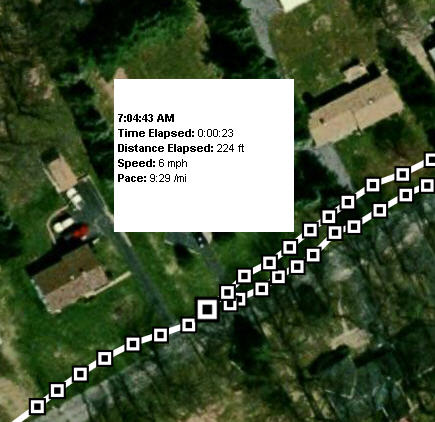
Last picture shows the information Garmin provides for each captured coordinate. It does not specifically highlight the laps and the provided info is almost useless - I'm not sure if anyone can use it. If you can let me know. I just can not imagine I would have use for immediate pace for each point and how far I traveled between two samples. But maybe I'm missing how to use it.


Garmin FR405 loc.jpg

Overall I like the way Polar depicts the path little better than what Garmin provides. I just wonder if and how Polar will depict the different zones - the example above is all in zone 1 as I did not even get my HR above 100 bpm and from there it is still long way to zone 2. When I'm able to run (probably some time next week after they remove staples from my leg) I'll do a few short bursts to get my HR all the way to zone 3 or 4 and see how Polar captures this. I'll also test the S3 sensor along with the G3 sensor. I did a short test last night and it works, but the test was like 200 meters so it does not really show much in GoogleEarth.

Other cool things I found is that the watch prompts you if you want to merge the exercises if you start new exercise within one hour of finishing the previous one and the watch has a new display for multi-sport view where it shows a combined distance, calories burned and combined time of the exercises. I still need to test out the transition from bike to run and see how the sensors need to be handled. Something tells me that it will not be as smooth as with the T6c where all you need to do is be more than 10 meters away from the other sensor - e.g. once you get far enough from bike sensor the watch picks-up your foot pod and changes the display from speed in mph (or km/h) to min/mi (or min/km). But I'll see how that works soon enough.

Soon I'll be selling some surplus stuff - Polar Power Sensor for the S625X/S725X, S210 HRM, Suunto T6c with comfort belt and probably one more HRM. Need to clean-up the desk again...


June 29, 2008

Q: Garmin Forerunner 405 or Suunto T6c?

Earlier last week friend of mine asked me the question in the title. I composed pretty lengthy response to his question to help him decide. It summarizes my experience with both HRMs. After reading it again I realized that there may be other people with similar question. Perhaps this one user summary will help you decide what to do. Please consider that I'm a triathlete and may have a different requirements from my HRM than pure runners (main being water resistance and second the support for multiple speed/distance sensors for tri racing). So here you go:

So you are on a quest as well? I just went through a number of HRMs and plan to sell some on eBay in the next few weeks. As for the 405 vs. T6c I think I can give you my take as I own and use both at the moment. It really depends on what you intend to do with the HRMs so I'll look at them from few angles.


Training planning


Garmin Forerunner 405 - Garmin has some planning functions (limited compared to RS800 from Polar), but you can structure the workout as you need which is quite nice especially for complex intervals training if you need to do it on treadmill. The result of planning is a guided workout in the watch that you can assign to particular day and the watch will let you follow it when you are ready to train.


Suunto T6c - has some planning capability in the software, but the guided workouts are to be defined directly in the watch. You can define warm-up duration, countdown duration (in case you want to do warmup, but not include it in the total exercise time), then there are two time intervals or you can use distance intervals (again only two). I find this fairly good for training and less robot like training - at times with the RS800 I felt like a robot executing a workout. The T6c gives you little more flexibility to adjust the workout as you feel just before you start. Very similar to S625X from Polar in terms of interval workouts.


Training


Garmin Forerunner 405 - the Garmin watch is great for running, OK for cycling and totally unusable for swimming. During running it connects to GPS very quickly and keep the connection just fine (despite the smaller size compared to 305). You can also use the foot pod (additional 99 USD) to keep track of your cadence during the runs. If the watch loses GPS connection it switches to the foot pod. You will need the foot pod on the treadmill if you use it. For biking you can get the bike pod, but I do not know much about it as I do not use it. The HR belt is fairly comfy, but it is a big rubber band like the very old Polar watches, but it is more comfortable. If you do not use HR belt Garmin approximates the calories expenditure, but the algorithm is weird - it told me my 56 miles bike ride burned 4500 calories. Yeah right. One nice thing is the GPS navigation - you can actually build track in the Google Earth or on the web like mapmyrun.com and transfer it to the watch as a course and then execute it. You can also take advantage of navigation if you do out and back run. The watch will guide you back to your starting position (through all the places you ran before) - basically backtracking home.


Suunto T6c - works like a charm for any sport and automatically switches between sensors (pods) if you use multiple - bike pod, foot pod, GPS pod. I use the watch with Memory Belt during swim and with comfort belt for running and biking. The comfort HR belt is very nice - even better than the Polar WearLink (the new one) and works very well once you figure out which part to moisten. The watch has configurable screens - 2 screens 3 lines each and the last line can show multiple items that you can switch between. I like it more than the Polar approach or Garmin approach (very similar - 3 items on each display and you switch between displays). What is really cool the watch switches between the sensors automatically. I did a brick today and it recorded my bike speed / distance (as 18mph), then I did a lap for transition and headed out of the house for a short run. Before I hit the street it was already switched to my foot pod and was showing my pace 18:30/mi and soon 7:45/mi. It is pretty cool to see this working after struggling with this with Polar, previous Suunto and Garmin. This may not be as important for one sport athletes, but quite nice for tri-geeks...


Evaluation of training


Well compared to Polar software both Garmin and Suunto have a long way to go.


Garmin Forerunner 405 - The evaluation software is pretty basic, but it has a nice feature of loading the GPS data and showing you the map of your run. It is nice, but to some degree it is a gimmick. It wears out pretty quickly. I mean how much do you need to know about where you ran around your house. It is nice though for all the business trips. Other than that the data is fairly basic and the data has the usual issues of the GPS sensor - the pacing data are fairly useless (quite an oscillation due to fluctuating GPS signal and the fact that the resolution is about 3-5 meters which does not really work well with immediate pace), I have very little confidence in calories burned. The HR data is very basic - no beat-to-beat info like in Polar RS800 or T6/T6c. Nice thing is that you can set your pace zones and HR zones and see how you did during the exercise. Overall I use the Training Center very little - mostly to load the courses or review the high level data.


Suunto T6c - the biggest difference between T6/T6c and other HRMs is the EPOC and TE. The standard STrM software does the basic analysis and shows you the
data recorded by the watch - R-R data, HR, speed / distance and all the parameters the software calculates based on the R-R. I use also the FirstBeat Athlete software mostly to help me look at my EPOC load during the week and month. I do get variety of the TE and EPOC based on how hard my training was, but it took me a while to fine tune the parameters. There are very good guides in the Wriststop Trainers group on Yahoo!. I fine tuned my parameters after few runs and Cooper running test. Since then my EPOC and TE makes a lot of sense and reflects how I felt during the training. I do review the detail mostly HR, R-R, EPOC and TE in both STrM and FirstBeat. FirstBeat seems to be more precise than the STrM especially for training of TE 1-2. For TE 3-4 the results are very similar. The T6c now shows the EPOC and TE during the workout and that is good, but not ultimately how I regulate my workout. I have my own training plan that I follow and use the EPOC / TE for overall evaluation at the end of the week to make sure my easy week is easy and build week is at least rated as moderate in the FirstBeat.


Daily use as a watch


Garmin Forerunner 405 - the watch can be used as every day watch, but it may be too large for people with small hands and people that need to wear shirts. It does not fit easily under the sleeve as it is quite bulky (the GPS needs to go somewhere). You will need to charge the watch every 3-4 days to keep it going. It has about 2 weeks of life with no GPS use and about 8 hours of continuous use of GPS. It is quite nice and the design gets you some attention. I heard people commenting on the watch and expressing interest to get one as well (mostly people doing some exercise).


Suunto T6c - It is a watch that you can use daily. It fits under the shirt and goes with any outfit. Since I got this watch it is my only watch that I use every day. I take it off only when I shower.


Cost


Note that this section reflects the situation as of June 2008. The prices are likely to change over time so do your research, check sites that sell Suunto watches and are certified by Suunto (you may not want to take chances with buying new watch from eBay and losing the warranty - I believe Suunto does not honor the eBay purchases. I actually called their support line before I purchased from Amazon to make sure they will honor the warranty).

Garmin Forerunner 405 - the watch is now about 350 USD + tax, foot pod about 99 USD and the bike pod 60 bucks


Suunto T6c - I got the watch for 320 USD (I guess I was lucky as the prices are back up to 429 USD on Amazon), foot pod for 90 USD and bike pod for 50 USD


So what it means for me - well I will continue to use both. I like the Garmin even with its shortcomings for recording speed/distance and position during running and biking. And the T6c is my primary HRM. Sometimes I run and bike with both, but most of the time you will find me with the T6c.


I do not have a simple answer T6c or 405, but you may be able to decide by reviewing my perceptions above and evaluatin what is important for you. I feel like I could live without the 405, but like to keep it as a second HRM.


If you want to research this topic even more there is a discussion thread on Suunto Discussions where I shared some more thoughts about the Garmin 405 vs. Suunto T6c more from a runner's point of view.

June 9, 2008

Garmin 405 - 4323 kcal during the bike ride my a**

This weekend I did a long bike around the lake Nockamixon - it is the race venue for my 2 races this year (the Steelman and EnduraSport Half Iron). It is a great 18.5 mile loop around the lake on rolling hills with two fairly good hills - one pretty steep and one fairly long. So it is a great place to ride and train for the terrain common in PA.

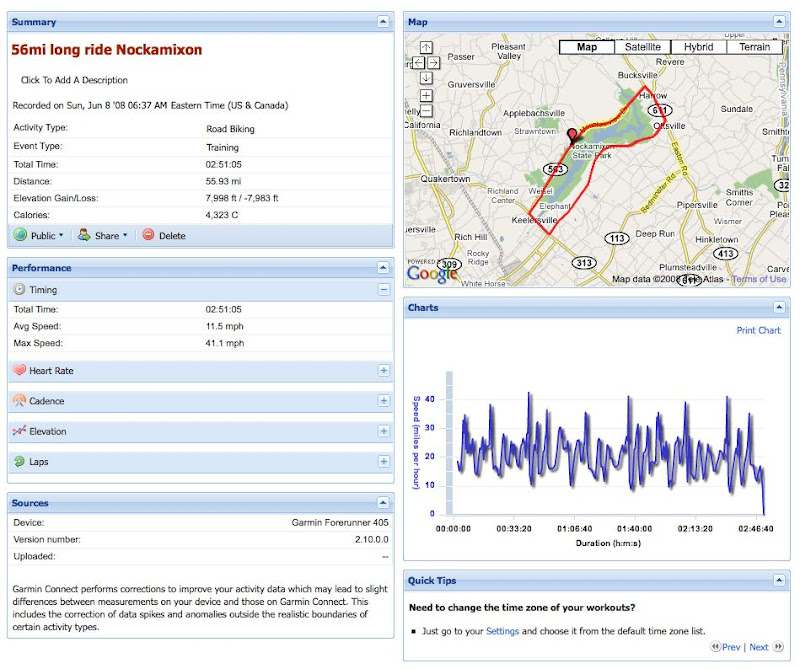
On this ride I took my Suunto T6 to monitor my HR, Polar S625X was strapped on the bike as a power meter and just for fun I threw the Garmin 405 in my pocket to get a GPS record of the ride. All went well and the ride was quite nice. I got it done before the huge heat wave came in. I had to re-fuel quite a bit. I may have made a mistake (again) of not taking salt tablets during the ride. But that is not why I'm writing this - the main reason is that as I use the Garmin 405 more and more I found another two major issues new users may need to worry about. I already wrote about the one issue with the elevation data that is just messed-up even on shorter runs or bike rides. But this weekend dring the ride I came across another issue related to energy consumption on the bike. I switched the 405 to bike mode, but even with that setting the darn thing thought I consumed 4323 kcals during the ride. Well not so - according to the Suunto log it is more like 1550 kcal which sounds more accurate. I'm seriously questioning the method Garmin uses to calculate calories. I like the Polar approach better - no HR = no calories information. Better than bad guess in my opinion. Difference between 4300 and 1500 is just too great to be useful.

Second new issue is related to software - Garmin Connect web site where the ride is reported as aerage speed of 11.5mph. Well the math just does not add up on this one - no matter how you slice it riding 56mi in 2:45 is more close to 20mph than to 11.5. Looks like they took the last lap average speed instead of averaging the speed over the entire distance. I hope they can fix this one quickly. The calory consumption issue shows up in the watch so Garmin you really need to release a fix the elevation data and the estimate of calories for biking. I do not burn 77 kcals per mile on the bike. It may be best not to estimate calories expenditure if there is no HR data provided. But that is just my uneducated opinion.

FirefoxScreenSnapz001.jpg

April 29, 2008

Garmin 405 review video

Today I'm turning geek again - I took about 20 minutes to record and edit the video review of the Garmin 405. I compared the watch size to Polar S625X, RS800 and Suunto T6. Let me know what you think and if you want to know more about any of the other features I did not cover.


April 27, 2008

Garmin 405 first impressions

forerunner405blackcf.jpg

Yesterday during the race expo I got the new Garmin 405 including the HR belt. I was thinking about it twice, but since they had them at the expo I had to get my hands on one. So far I ran only once with the unit and as a matter of fact it was my first A-race of the season. The Garmin watch really helped me a lot to keep even splits during the half marathon as you can see on Garmin Connect record. I'm not yet ready to do a full review of the watch since I can not really judge it after just one run. But here are few observations I made so far.


The good


  • The form factor of this new watch is just great. It looks like watch, is small as a watch and still has the Garmin GPS capabilities built in. It also looks good - understated design - not much showing while in the power save mode.
  • Navigation in the menu is very easy and using the bezel of the watch is very intuitive. Watch has only 2 buttons and 4 touch areas on the bezel. Navigation and access to the menu is very easy.
  • The fit is great - it snugly fits around the wrist and is very easy on the hand even in long races (I had it on my right arm where I usually do not have a watch).
  • The GPS signal gets picked up very fast (compared to regular car GPS units or the Polar GPS sensor that I use).
  • The watch is little bigger than the Polar RS800, but not much bigger. It feels very sturdy - something like Suunto T6 or Polar S625X. With the RS800 I sometimes fear that the watch is to fragile.
  • The ANT connection to the computer is in one word amazing. When I got home I walked into my office and the computer picked-up the activity recording and transferred it to the Garmin Training Center and Garmin Connect. Without me even logging onto the machine (it was locked from last night).
  • Garmin apparently built in capabilities to program guided workouts - seems very similar to RS800. I have not used it yet, but from the pre-delivered workouts it looks very easy to build the workout and execute it.
  • According to the manual the 405 can calibrate foot pod based on the GPS data during the run. Something Suunto and Polar users were asking for their manufacturers. I'm not sure how good it is as I do not have foot pod to test it.
  • The watch lets you setup virtual partner which was what kept me on pace today during the race.
  • The accuracy of the watch is very good - all the splits came within a meter or two of the official race mile markers. The only exception was the mile 10 where I was about 20 meters behind the marker when the lap got recorded. I think it may have been the tree cover or just misplaced mile marker. In any case I did not seem to lose the GPS signal even while running under the trees. I did not check the accuracy for obvious reasons, but I may do that on one of the training runs.
  • Battery life is rated as 8 hours of running with GPS on and about 2 weeks in power safe mode. I can only tell you that after being fully charged last night I used the watch for the half marathon, transfer to the computer and it shows 80% battery life left. I also left the default settings of 55% brightness and beeping of the buttons, bezel and while running.


Stuff that can be annoying to some people


  • The bezel is extremely touch sensitive. One needs to remember to lock it when you put your shirt over the watch otherwise it may lead to some unwanted actions on the watch. Like switching on the GPS when you are indoors. But learning to press the two buttons to lock the bezel is very quick. I had the watch only 12 hours and knew what to do.
  • At this point the 405 is not supported on Mac, but I assume that will get corrected over time. I do not mind as I use PC for my workout recording, but some Mac zealots may find it disturbing.
  • I did not find anything that I would not like about the watch. I actually had to think long time to come up with the two above items. But hey I used it only for less than 24 hours so there may be things that pop-up later. I'll post them here.


OK that is all I could come up with after quick read of the manual, quick setup of the watch and one run with it. Let me know what you want to know for the review so I can look into it before I post again.

January 5, 2008

Garmin to release a new watch

Forerunner 405 blackGarmin announced that they will release a new running watch in their Forerunner line. The Forerunner 405 which very much resembles the Forerunner 50 and delivers GPS technology not available in the 50. The watch will be available late in Q1 2008 - should be just around the time for the half marathon that is sponsored by Garmin. So I hope to be able to check it out at the expo. If you are interested to learn more details you can check out the Garmin site or Garmin blogs. The Garmin blogs post has a short demo of the watch. It looks quite nice and very small compared to Forerunner 205 or 305. If you are heading over to Vegas for CES make sure to stop by Garmin and check out the watch (along with some nice new GPS units for hiking and cars.