Showing posts with label race analysis. Show all posts

May 8, 2009

Lehigh Valley Half race review

This is not a full and detailed analysis of the race, just a recount of the race mile by mile and discussion of the pacing during each race segment. I do think I may have run it little differently if I was not hit by the GI issues, but overall I ran as good I could on the day. I do not have splits for every mile as I missed few mile markers along the way, but the available splits provide sufficient picture to understand how things unfolded. If you plan to run Lehigh Valley Half next year this may be helpful for your race planning.

MileAverage pace
17:10
2-37:06
4-57:16
67:14
7-87:23
9-107:25
117:28
127:20
13.17:00


From the splits it is apparent that I did not quite run negative split race. But even without negative split I ran pretty even race considering the course and conditions (mostly mine).

The course is downhill for the entire first mile. I was able to restrain myself from going too fast in that section. That is mainly because the 6:30 pace group leader also chose slower pace on the first few miles and I was staying with that group for first mile or two. Mile 2-3 are mostly flat or slightly downhill. In this section I was still adjusting my pace to settle into what seemed like a comfortable pace. Little faster than the planned 7:10 - 7:15 pace. At the end of the mile 3 I got the $#%*& gel. The slight rolling starts around the end of mile 3 and goes on for the next 2 miles. My pace slightly dropped in this section I guess due to the fact that I walked the aid station to get enough water. I picked-up the pace slightly on mile 6 and was within the range. From mile 7 the race moves from road to trail where you can expect slight drop in pace. But mine dropped more than planned due to the GI issues. The rough patch in this race for me was between the miles 9 and 10. That is where there are not many spectators with exception of the covered bridge and aid stations. It is nice area and I love to run there for training run, but in race it is probably the hardest part of the course to deal with. Mile 11 was the slowest due to two things - walked the aid station and it has two biggest climbs of the course. First one is right at mile 10 marker and the second is just about 500 meters further down the road. The course then turns back to road. On mile 12 there are two slight uphills after the aid station as the course turns back towards the starting line (you basically run the second mile here in the opposite direction). I was working quite hard on mile 12, but I guess the climbs took their toll. I did not take in any more water or nutrition at this point. When I hit the mile 12 marker I just unleashed all I had left and ran my heart out. I build up the pace towards the stadium - saving energy a little on climbs and then picking-up the pace on flats (no more downhills here). Once I had the climb to the stadium behind me I just ran as fast as I could manage. The average pace on that stretch is sub 6 minute mile, but it is only 3/4 of a track so it is just about 300 meters.

So there you have it blow by blow. Few days after the race I'm really happy with how I ran it. There are few things that I could have done better, but all in all it was a well executed race and surprisingly I did not suffer in it as much as in other half marathons. The tempo and progression long runs make all the difference. Thanks Craig for helping me come this far. It is 20 minutes improvement over my very first attempt at this distance only 2 years ago.

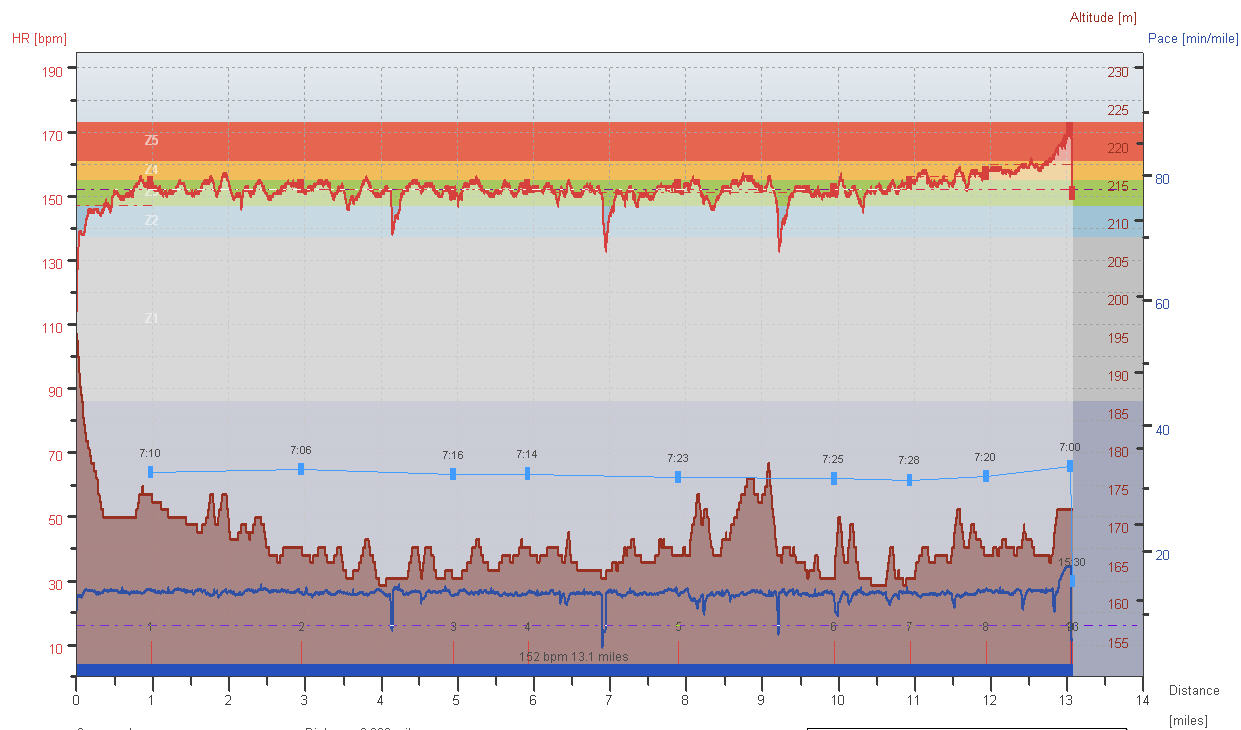
And if you want to look at the course altitude profile (filled area), pace (blue lines) and HR (red line) see the log below.
LV-Half.jpg

December 8, 2008

How to run marathon in 3:55 when you shoot for 3:30

Few days after completing the marathon in Philly I wanted to find answers why I did not have the race I wanted. I did a full review of the race, looked at my heart rate monitor log from the race and mentally walked through the whole race. I summarized my findings and ran them by Craig who confirmed most of them and added few findings to complete the picture. Here is the summary of what made the day go the way it did. I made some rookie mistakes and paid for them dearly. I suggest you review this article before your next marathon. It may help you get a better race.

  • Prepare good race plan - I had a very basic race plan going into the marathon and as the day unfolded I found the race plan was not thought through well enough to carry me through the day. I did have just plan A. I did not have plan B, C and D as I usually have and had to change things on the spot as the race went. You may know that the longer you run the less you can rely on thinking clearly. According to Craig I did pretty good job reacting to the circumstances and changed the tactics according to conditions. I also pushed through the rough spot between miles 18 and 21 when I felt really bad. I may have performed better if I had more detailed plan. But it is hard to build one if you do not really know what the race will be like. Just like my first HIM race I blew-up on the run. But next year my HIM was without any blow-ups. I'm learning by mistake.
  • My water intake during the race was not sufficient. The cold weather made me think that I do not need to take in water. I should have drank at least a bit at every aid station instead of sticking only with the Perpetuem mix I had in my bottles. According to Craig I took in more than enough carbs (actually about 40 calories per hour more that I should have) and not enough water. Which made me feel bloated and and my stomach was full of fluids that were not processed. I should have stuck with my other fuel belt with two large bottles or I should have drank water at the aid stations.
  • Never try to play catch-up during the long distance race. I mentioned in my race report that I had to stop at around mile 10 for quick bio break. I lost contact with the pace group and at that point I got the stupid idea that I can catch-up with them by picking-up the pace a bit. It was actually quite easy as from the point I took the break the road was downhill. This was by large my biggest mistake of the day. I looked through the log and it looks like I just killed my race on that downhill. I basically ran too fast down that hill - from average pace of 8:00 min/mi I sped up to 6:40 min/mi on the downhill. Yeah you read correctly I was running at higher than my 5k pace race during the marathon. Silly me. About a mile after that heroic effort (after I settled back to 8:00 min/mi) I had to take a walk break. First of many walk breaks.
  • Get better clothes that protect from cold wind. I believe I ran in enough clothes for the race conditions, but I did not account for the wind especially on the stretch on Kelly Drive. Although I had base layer, warm compression shirt with long sleeves, long sleeve compression top, long compression pants and two hats (one for wicking the sweat and one to keep me warm) I never felt completely comfortable. I was more on the cold side the entire race. I think I should have had either different base layer (the one I had feels cold against the body) or I should have a wind protection layer. I will need to experiment with this during the winter.
  • I need to get better timing of the bathroom breaks. I should have used the time after warm-up to get to the bathroom. That way the 10mi stop would not be necessary. Well I just hate the porta-potties lines at race venues.
  • Hard races at the end of long season are not easy to prepare for - I had hard time getting my head in the game for this one. I posted comment in the original race report about this. As I said I did not want to break the 3:30 bad enough and was not mentally ready to push very hard. If I run another marathon I'll be better equipped.

So there you have it. In case you wanted to look at the breaking point in my race here are two pictures - first one shows the altitude, pace, heart rate for the entire race and the second one zooms on the critical part of the race. E.g. the part where I stopped for bathroom break and then sprinted down the hill. I still can not comprehend what I was thinking at that time. Another reason to have good race plan not to kill your race before the half point.

Marathon_Full.jpg


Marathon_BlowUp.jpg

So there you have it. If you can prevent the above mistakes I made - especially trying to play catch-up you will do better on the race day. Good luck everyone.

September 16, 2008

Quakerman HIM race analysis

I usually do the race analysis for my A-races, but the result of the Quakerman Half Ironman race was quite surprising for me as I did not specifically train this season for HIM distance and still placed well in the race overall and also in my age group. The race report is in one of the earlier posts on this site. In this post I'll focus on performance in each leg.


Swim 1.2mi (36:13)

The swim leg started pretty tough as the whole 85+ field started in one wave, but separated pretty soon. I kept focused on the improvements of my swimming that Erica recommended and kept swimming at reasonably good pace. I was not pushing the pace though as there is really no point to do that in such a long race where the swim leg represents fairly short part of the overall race. I may start pushing more going forward, but in this race I wanted to take it conservatively to prevent any blow-ups later in the day. I had few surges as I tried to keep-up with my draft few times, but when I lost contact I did not push harder to catch-up. It just did not seem like a good strategy. I started pushing little more on second lap, but stayed within reasonable RPE that allowed me to breathe with no troubles. I exited the water in 36:13 which is very good for me. Almost 5 minutes behind the overall winner and about 3 minutes faster than last year so definitely an improvement.

I usually do fairly fast T1, but this one was very close to be a messy one - as I wrote in the original race report I almost took my bike without putting on my helmet and that would be a sure DQ. The T1 time was 52 seconds which is 13 seconds behind the winner, but that is not very significant. After comparing my times with other people I noticed that my swim split was 19th overall, but I left transition as 17th - I passed two people in transition. Just shows you that fast transitions are quite important if you want to race well.


Bike 56.7mi (2:40:19)

Onto the bike leg. I followed Craig's guidance and started conservatively, kept my power output within the limits we set for each split of the bike. I started taking in nutrition about 10 minutes into the bike and kept it up knowing that nothing beats a great lunch on the bike. All jokes aside - bike is the only leg in the race where you can take in significant amount of nutrition. Any eating during swim is impossible and during the run the intake level can not be kept as high as on the bike.
The bike course was 3 loops around the lake and I overtook a good number of people on the first half of the first loop and then rode pretty much alone. I started to catch-up with few riders every 10-20 minutes after that. I usually slowly caught-up with a group of 2-3 people and passed them slowly over few miles. I was not hammering to pass people as I did during the Steelman, I was saving my legs for the run. On second loop Erica told me (very loudly :-) that I'm sixth overall. That was very encouraging as I had no idea where I was in the field. Looking at the bike split I entered the transition as 6th overall about 5 minutes after a guy in 5th place and 3 minutes ahead of the guy after me. This still meant that I was 17 minutes behind the overall leader (and there was no way he was letting anyone pas him on the run - ran the whole 13.1mi at 6:36 min/mi - wow that is some speed). T2 was very fast even with taking the shoes and socks from ziploc bag as I did not want them get wet before the run start. The T2 time was 44 seconds and was very close to the leaders.


Run 13.1mi (1:49:45)


I started the run pretty fast, but then slowed down knowing I can not sustain running that fast for very long. My overall pace for the run was 8:20 min/mi, but I'm very sure I did run slower in the second half than the first one. I kept the fluid and gels intake every 10-15 minutes sipping from gel flask. At the beginning of the race I decided that I'm racing to beat my last year's time and that I'll not necessarily follow people that pass me. And I stuck with that strategy through out the run leg. I had four people pass me on the run and they all ran sub 8:00 min/mi. I re-passed few guys that passed me in the early stages of the run and then blew-up, but I did not catch-up to any of the people that finished biking ahead of me or the four that passed me with and looked very strong. Run is definitely area that I need to work on (along with swimming where I can already see good progress from changing the way I swim).

The per leg stats show that I placed 19th in swim, 6th on the bike and 26th on the run. If I was able to sustain sub-8:00 min/mi pace it would have placed me at 19th spot in the run leg and would improve my overall time by about 5 minutes. I guess more threshold running and intervals are in store for me - endurance is there, but keeping the pace up for entire half marathon seems to be an issue after the swim and bike.

Update: In all the excitement I did not include the final tally: the overall course time was 5:07:53 which was 10th overall and 2nd in my age group. If you want to take a look at the results you can find them on this site. The event also posted pictures and all mine are in the lost and found. I found 10 pictures can you?


Course profile


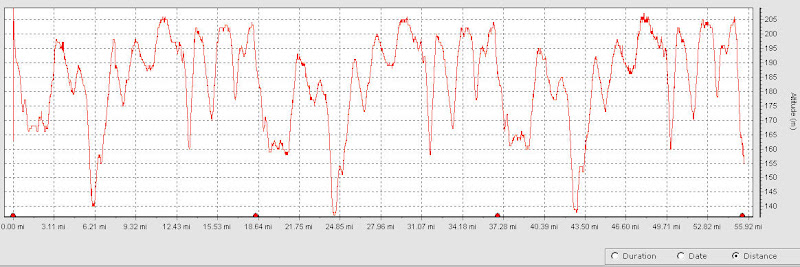
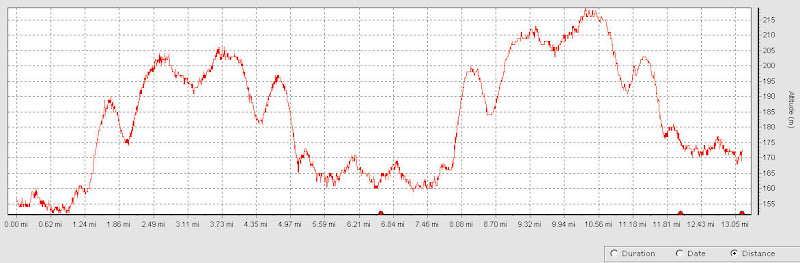
Few friends commented on the race results and I just wanted to share two pictures with you and people that plan to do this race - it is hilly on both bike and run. The pictures below show the course profile - top one shows bike and bottom one run course. You can see that the elevation profile on second loop of the run is slightly shifted in the picture - that is due to the weather change in the middle part of the run - from cloudy to rain.Quakerman HIM bike profile.jpg
Quakerman HIM run profile.jpg

August 17, 2007

Post Race Analysis

So my first race is behind me and now is time to sit down and do analysis of my performance so I can use the Steelman and a spring board for the half iron in September. Monday night I downloaded the Olympic distance results, eliminated all the DNFs and started looking at how I did compared to complete field, only mens and my age group. I focused mainly on the age group analysis as that should help me determine what I need to focus on to move up in the ranks. Here is the result of the analysis:

  • Complete field (306 finishers)

    • Swim 125
    • T1 204
    • Bike 74
    • T2 108
    • Run 172
    • Finish time 94

  • Mens (231 finishers)

    • Swim 97
    • T1 149
    • Bike 65
    • T2 82
    • Run 133
    • Finish time 79

  • Age group (31 finishers)

    • Swim 14
    • T1 23
    • Bike 12
    • T2 14
    • Run 20
    • Finish time 15


After this initial placement analysis I looked at how much slower I was in each discipline compared to the age group winner and also to the person who did best in that particular leg in my age group. So here we go, the first time is the age group winner and the second one is the person from my age group who did best in that particular leg in the race. All times are shown in min:sec format:


  • Swim 4:41, 9:06
  • T1 1:08. 1:35
  • Bike 7:54, 7:59
  • T2 0:13, 0:33
  • Run 7:41, 11:47
  • Finish time 21:37, N/A


So what can I read from all this?


  • I had pretty good bike and fairly fast T2.
  • Although I scored fairly high on the bike I could have done better. That bio break cost me good minute or two and if I improve my aero position (I suspect that my seat position is not optimal) I can shave off few more seconds maybe even minutes in the 56 miles ride that is in the next race.
  • My T1 time is horrible - almost twice the time as age group winner (only 25% of my age group peers were slower than I was in T1).
  • My swim was not great, but I did not have a bad time even though I did more than 50% of it doing back stroke and breast stroke. Wow that is a surprise.
  • My run is little on the slow side. I'm slower than average runner in any group (e.g. I'm in the slower half of the field, not by much but anyways in the slower group).

Now that I know how I did what does it mean for the short term training focus - read next 3 weeks until the Quakerman Half Ironman. I will continue with the training schedule, but I need to re-focus or insert additional practice in specific disciplines:

  • Swim - need to continue working on my swim including pacing and breathing. I will need at least one open water swim at Bethlehem Dutch Springs to have a real long swim practice. Pool practice does not prepare you for a long swim - hey tri-newbies listen to this - go find a lake before your race and have at least one long swim in the open water. The visibility in the water is different than in the pool and also it is a different feel to keep swimming for full 40 minutes without hitting a wall.
  • T1 drills are a must - I'll need to practice getting wet out of the pool in the wet suit, running around the pool and getting into my bike shoes, helmet and running with the bike. I did practice the run with the bike in my bike shoes before the race, but it was not enough to get me fast through T1.
  • For the bike leg I will be getting a better fit on the bike - I already scheduled appointment for Monday. I'm also expecting a new aero bike helmet early next week so I will have at least one long ride with it next Saturday. That should help during the race. And also more time on the bike will help me get even better speed especially for the hills. I'm not a very good climber.
  • T2 - few practice drills may help to get few seconds off of my time, but this is really not such a big deal.
  • Run - I wish I had more time to work on the speed, but that is not the case. For few weeks now I have tried to stay within the recommended pace for each run as the FIRST running program dictates it. But my tri-training plan does not have 3 weekly runs every week so I'm not 100% following the FIRST plan. I adopted the pacing recommendations for my runs and I try to stay as close to the recommended pace as possible. I can see some speed gain already - e.g. my 10k time during tri race being better than my 10k time in February. But the speed gain is not enough to help me move up in the run placement. I may also look into my race pacing plan for the run leg and be little more aggressive in my pacing than during the Steelman. I may have been a little conservative not knowing what my legs will feel like during the race. This is definitely an area that I will work on in the next months.

Thanks to doing Steelman I now know what are my weak spots. Before then I was only guessing. Now I know that next year is going to be mostly about running speed and swimming.