July 25, 2008

Doing it for 2 years today

This morning two years ago was the first day of the new Jan. That morning I laced-up my brand new Nike+ shoes with Nike+ sensor, put on the shiny new iPod Nano and went out for first run. Well now looking back at it it may not have been exactly running, but hey I was moving and doing positive steps. My motivation was to improve my fitness and lose the extra weight that I carried back then (well over 20 kilos to be exact). I was dead after 1.5 miles, but I was happy that I'm doing something to get back into shape. Day later I was back on the road and running another 1.6 miles and I have been doing this since then. Few months later I ran my first 5k - you can see the time on the right side of this page. Then I ran another 5k and my weight loss motivation got a friend - I wanted to get leaner and faster.

Fast forward to January 2007 when I started to feel little bored with just running. I started to think about adding another sport. At the same time I came across book from Joe Friel, read it in two days and was ready to make the plunge to triathlons. I knew I'll stick with it so I went full bore - tri-bike, treadmill (to make the training easier during the winter time and when I can not leave the house), and bunch of other stuff that one needs to get into triathlon. Luckily I already have pool in the backyard otherwise I do not think my wife would be too pleased if I had someone build one for us and justify it with tri-training :-).

And since then I do this swim, bike, run thing and love it. I would not necessarily say that I'm very good at it, but I'm definitely getting better and moving up in the score lists in the races. I got lucky last year when I finished 2nd in my AG in local Half Iron race and two weeks later took 3rd in local sprint race. This year I was 49th in Black Bear sprint (9th in AG) and last weekend 22nd in Anthracite Oly (6th in AG). Definitely an improvement, but here are still few things I need to work on to get better - can you say swimming and running... One thing surprises me though - I never knew I would do so good in biking part of the races. I guess the bike riding as a kid shows in my race results - as kids we usually took bikes to the lake and it was a good 45 minutes bike ride away. On the way to the lake we were descending a steep hill and that is probably helping me with my bike handling skills - I literally have no fear on descends (case in point - in the Anthracite Tri the first steep downhill ended in sharp turn - I still did over 49 mph (80km/h) on the downhill with no fear and made the turn nearly taking the cop that was at the intersection). I also do fairly well on the climbs - I guess it must be related to the rides home from the lake - we needed to climb back up the steep long hill after being pretty tired from all the swimming and running around the lake. Now only if my swimming and running were as good. I guess I still have a lot of laps and miles to do to improve on those two fronts...

July 12, 2008

3000 miles on the Specialized

Yesterday while I was logging my workouts to TrainingPeaks I added my new shoes and retired my old shoes. While I did that I noticed that I'm 4 miles short of 3000 miles on my triathlon bike. Wow that is pretty good considering I do not ride all that much. I bought the bike in March last year. I hope it holds well for another 3000 miles. Now I wonder how soon the wheels will need to be replaced. I may just buy some race wheels and use the ones on the bike just for training. Anybody has any idea how long Mavic road bike wheels last? I do not really want to spend any money on wheels this year if possible.

July 7, 2008

Selling off some surplus HRMs

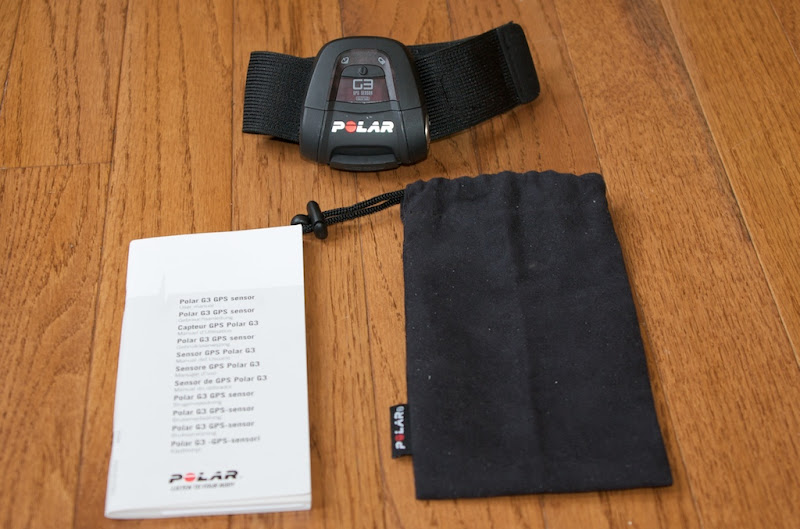
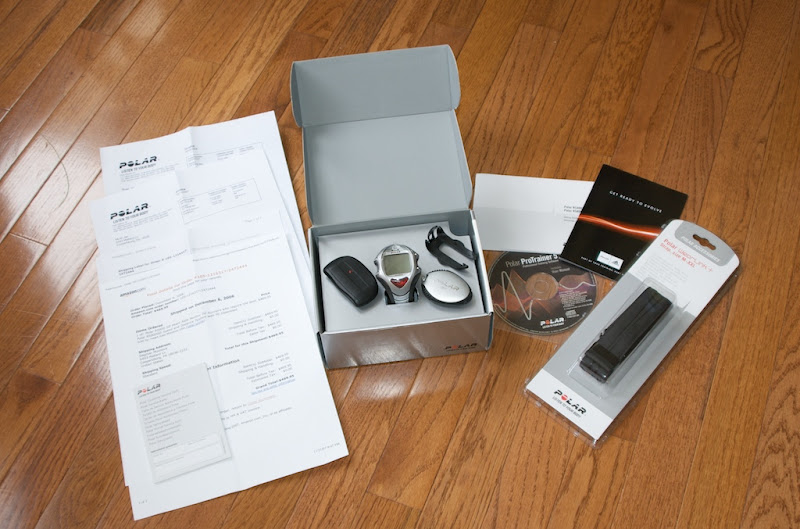
I used the long weekend to review the stacked boxes with Heart Rate Monitors and decided to sell off few items that I no longer use. In case you wanted to check out the eBay auctions click on the picture below:


DSC_6430.jpg


DSC_6426.jpg


DSC_6413.jpg


UPDATE: The RS800sd is sold. The remaining two are still open for bids.


July 1, 2008

New Polar RS800cx due late 2008

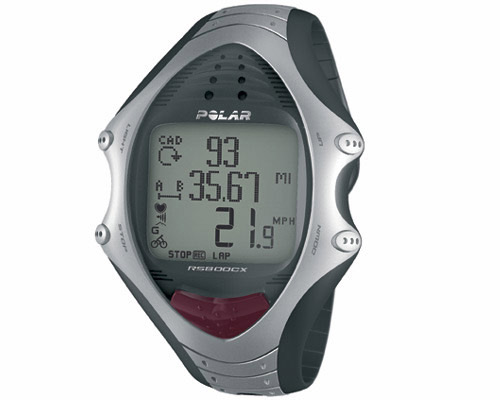
Following some speculation and rumors about the new Polar HRM here are more rumors and picture of the anticipated new Polar RS800CX device. This is a copy of what has been posted in the Polar discussion forums on Yahoo! earlier today:

The new Polar RS800CX Training Management System- now with GPS route tracking and multisensor compatibility- is the most advanced and flexible training tool for the multisport market. The RS800CX is essential for multi-discipline and endurance athletes looking for an accurate way to measure, plan, monitor and analyze their training. In addition to speed and distance, the RS800CX records positioning information with the G3 GPS sensor(tm) and enables users to download route information into the included ProTrainer 5 Software(tm). Route information can also be easily exported to Google Earth mapping software. The sleek, lightweight RS800CX wrist unit is compatible with the range of Polar W.I.N.D. sensors, including the s3 Stride Sensor(tm) and CS Cadence and Speed Sensors(tm). The multisensor functionality allows users to combine different sport sessions into one training file for an enhanced training experience. Available Fall 2008.

product-large-8002231.jpg

Earlier one of the forum members posted the following text that complements and confirms the rumor (note that Polar did not announce this product yet, but the forum turned out to be quite accurate in the past when Polar was about to release the G1 GPS sensor for the S625X/S725X line):

The RS800CX will be compatible with the following accessories.

  • G3 - GPS
  • S3 - Stride Sensor
  • CS W.I.N.D. - Speed Sensor
  • CS W.I.N.D. - Cadence Sensor
  • CS Power - No compatibility.
There are some upgraded features like automatic switching between known measurement devices, and compatibility with Google earth. It is unclear weather current RS800G3 users will be able to use this new map feature. The software will have several upgrades, like full workout files even when using different devices (triathlon/ mutlisport) and the mapping. I was also not able to find out if the Heart rate zones will auto swap between zones (HR zones associated with speed sensors). I use a CS600 w/ Power and an RS800sd and have no problems with merged files and My HR/ Power zones are always accurate to the sports I am doing, no mental calculations during the race. My other question is how the HR/ Zones woudl be notated in the graph if the unit did switch zones auto style. No answer as of yet.

The current RS800 users on the market will not be able to start using bike sensors. this is a new unit based on the orginal RS800 platform. Think S725 to S725x type change.


Most likely not available till octoberish.

From what I'm reading in this semi-announcement Polar will upgrade the RS800 line to get GPS mapping, compatibility with the CS bike sensors (with exception of power - I hope this is not true as if they had power they would have it all - speed / distance / cadence / GPS mapping / power / multiple sensors in one session). If they bring in the Power sensor to the fold this would be the ultimate triathlete device with multi-sensor support and power. Otherwise with the exception of mapping and running cadence the features are already available in Suunto T6c with the multi-sensor support. The only thing I'm still missing in T6c is the running cadence and integration with power sensor. It would be nice if Suunto added at least the run cadence as it is technically possible to determine (Garmin does it with pretty much the same sensor as Suunto uses in their line).

June 30, 2008

Speedy bike

I really need to get one of those for my upcoming race.


June 29, 2008

Q: Garmin Forerunner 405 or Suunto T6c?

Earlier last week friend of mine asked me the question in the title. I composed pretty lengthy response to his question to help him decide. It summarizes my experience with both HRMs. After reading it again I realized that there may be other people with similar question. Perhaps this one user summary will help you decide what to do. Please consider that I'm a triathlete and may have a different requirements from my HRM than pure runners (main being water resistance and second the support for multiple speed/distance sensors for tri racing). So here you go:

So you are on a quest as well? I just went through a number of HRMs and plan to sell some on eBay in the next few weeks. As for the 405 vs. T6c I think I can give you my take as I own and use both at the moment. It really depends on what you intend to do with the HRMs so I'll look at them from few angles.


Training planning


Garmin Forerunner 405 - Garmin has some planning functions (limited compared to RS800 from Polar), but you can structure the workout as you need which is quite nice especially for complex intervals training if you need to do it on treadmill. The result of planning is a guided workout in the watch that you can assign to particular day and the watch will let you follow it when you are ready to train.


Suunto T6c - has some planning capability in the software, but the guided workouts are to be defined directly in the watch. You can define warm-up duration, countdown duration (in case you want to do warmup, but not include it in the total exercise time), then there are two time intervals or you can use distance intervals (again only two). I find this fairly good for training and less robot like training - at times with the RS800 I felt like a robot executing a workout. The T6c gives you little more flexibility to adjust the workout as you feel just before you start. Very similar to S625X from Polar in terms of interval workouts.


Training


Garmin Forerunner 405 - the Garmin watch is great for running, OK for cycling and totally unusable for swimming. During running it connects to GPS very quickly and keep the connection just fine (despite the smaller size compared to 305). You can also use the foot pod (additional 99 USD) to keep track of your cadence during the runs. If the watch loses GPS connection it switches to the foot pod. You will need the foot pod on the treadmill if you use it. For biking you can get the bike pod, but I do not know much about it as I do not use it. The HR belt is fairly comfy, but it is a big rubber band like the very old Polar watches, but it is more comfortable. If you do not use HR belt Garmin approximates the calories expenditure, but the algorithm is weird - it told me my 56 miles bike ride burned 4500 calories. Yeah right. One nice thing is the GPS navigation - you can actually build track in the Google Earth or on the web like mapmyrun.com and transfer it to the watch as a course and then execute it. You can also take advantage of navigation if you do out and back run. The watch will guide you back to your starting position (through all the places you ran before) - basically backtracking home.


Suunto T6c - works like a charm for any sport and automatically switches between sensors (pods) if you use multiple - bike pod, foot pod, GPS pod. I use the watch with Memory Belt during swim and with comfort belt for running and biking. The comfort HR belt is very nice - even better than the Polar WearLink (the new one) and works very well once you figure out which part to moisten. The watch has configurable screens - 2 screens 3 lines each and the last line can show multiple items that you can switch between. I like it more than the Polar approach or Garmin approach (very similar - 3 items on each display and you switch between displays). What is really cool the watch switches between the sensors automatically. I did a brick today and it recorded my bike speed / distance (as 18mph), then I did a lap for transition and headed out of the house for a short run. Before I hit the street it was already switched to my foot pod and was showing my pace 18:30/mi and soon 7:45/mi. It is pretty cool to see this working after struggling with this with Polar, previous Suunto and Garmin. This may not be as important for one sport athletes, but quite nice for tri-geeks...


Evaluation of training


Well compared to Polar software both Garmin and Suunto have a long way to go.


Garmin Forerunner 405 - The evaluation software is pretty basic, but it has a nice feature of loading the GPS data and showing you the map of your run. It is nice, but to some degree it is a gimmick. It wears out pretty quickly. I mean how much do you need to know about where you ran around your house. It is nice though for all the business trips. Other than that the data is fairly basic and the data has the usual issues of the GPS sensor - the pacing data are fairly useless (quite an oscillation due to fluctuating GPS signal and the fact that the resolution is about 3-5 meters which does not really work well with immediate pace), I have very little confidence in calories burned. The HR data is very basic - no beat-to-beat info like in Polar RS800 or T6/T6c. Nice thing is that you can set your pace zones and HR zones and see how you did during the exercise. Overall I use the Training Center very little - mostly to load the courses or review the high level data.


Suunto T6c - the biggest difference between T6/T6c and other HRMs is the EPOC and TE. The standard STrM software does the basic analysis and shows you the
data recorded by the watch - R-R data, HR, speed / distance and all the parameters the software calculates based on the R-R. I use also the FirstBeat Athlete software mostly to help me look at my EPOC load during the week and month. I do get variety of the TE and EPOC based on how hard my training was, but it took me a while to fine tune the parameters. There are very good guides in the Wriststop Trainers group on Yahoo!. I fine tuned my parameters after few runs and Cooper running test. Since then my EPOC and TE makes a lot of sense and reflects how I felt during the training. I do review the detail mostly HR, R-R, EPOC and TE in both STrM and FirstBeat. FirstBeat seems to be more precise than the STrM especially for training of TE 1-2. For TE 3-4 the results are very similar. The T6c now shows the EPOC and TE during the workout and that is good, but not ultimately how I regulate my workout. I have my own training plan that I follow and use the EPOC / TE for overall evaluation at the end of the week to make sure my easy week is easy and build week is at least rated as moderate in the FirstBeat.


Daily use as a watch


Garmin Forerunner 405 - the watch can be used as every day watch, but it may be too large for people with small hands and people that need to wear shirts. It does not fit easily under the sleeve as it is quite bulky (the GPS needs to go somewhere). You will need to charge the watch every 3-4 days to keep it going. It has about 2 weeks of life with no GPS use and about 8 hours of continuous use of GPS. It is quite nice and the design gets you some attention. I heard people commenting on the watch and expressing interest to get one as well (mostly people doing some exercise).


Suunto T6c - It is a watch that you can use daily. It fits under the shirt and goes with any outfit. Since I got this watch it is my only watch that I use every day. I take it off only when I shower.


Cost


Note that this section reflects the situation as of June 2008. The prices are likely to change over time so do your research, check sites that sell Suunto watches and are certified by Suunto (you may not want to take chances with buying new watch from eBay and losing the warranty - I believe Suunto does not honor the eBay purchases. I actually called their support line before I purchased from Amazon to make sure they will honor the warranty).

Garmin Forerunner 405 - the watch is now about 350 USD + tax, foot pod about 99 USD and the bike pod 60 bucks


Suunto T6c - I got the watch for 320 USD (I guess I was lucky as the prices are back up to 429 USD on Amazon), foot pod for 90 USD and bike pod for 50 USD


So what it means for me - well I will continue to use both. I like the Garmin even with its shortcomings for recording speed/distance and position during running and biking. And the T6c is my primary HRM. Sometimes I run and bike with both, but most of the time you will find me with the T6c.


I do not have a simple answer T6c or 405, but you may be able to decide by reviewing my perceptions above and evaluatin what is important for you. I feel like I could live without the 405, but like to keep it as a second HRM.


If you want to research this topic even more there is a discussion thread on Suunto Discussions where I shared some more thoughts about the Garmin 405 vs. Suunto T6c more from a runner's point of view.

June 9, 2008

Garmin 405 - 4323 kcal during the bike ride my a**

This weekend I did a long bike around the lake Nockamixon - it is the race venue for my 2 races this year (the Steelman and EnduraSport Half Iron). It is a great 18.5 mile loop around the lake on rolling hills with two fairly good hills - one pretty steep and one fairly long. So it is a great place to ride and train for the terrain common in PA.

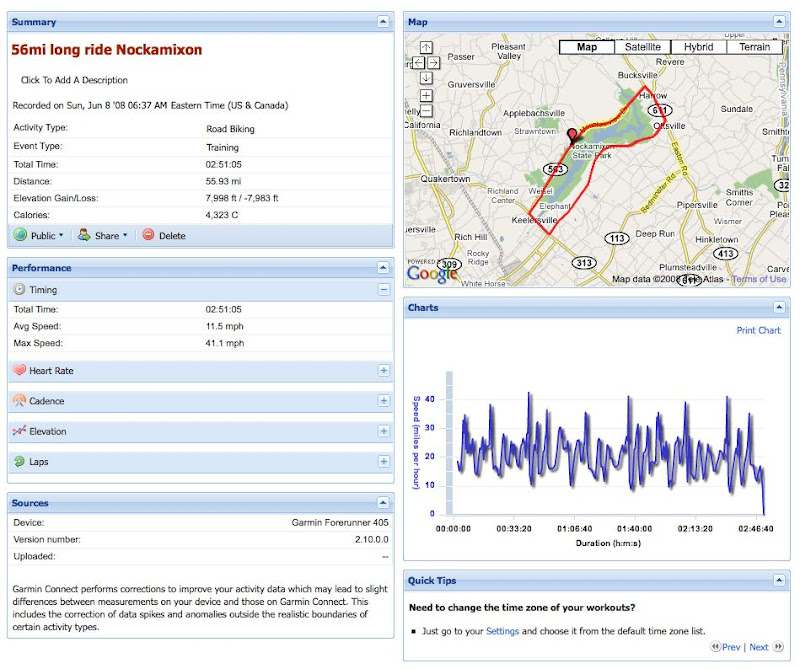
On this ride I took my Suunto T6 to monitor my HR, Polar S625X was strapped on the bike as a power meter and just for fun I threw the Garmin 405 in my pocket to get a GPS record of the ride. All went well and the ride was quite nice. I got it done before the huge heat wave came in. I had to re-fuel quite a bit. I may have made a mistake (again) of not taking salt tablets during the ride. But that is not why I'm writing this - the main reason is that as I use the Garmin 405 more and more I found another two major issues new users may need to worry about. I already wrote about the one issue with the elevation data that is just messed-up even on shorter runs or bike rides. But this weekend dring the ride I came across another issue related to energy consumption on the bike. I switched the 405 to bike mode, but even with that setting the darn thing thought I consumed 4323 kcals during the ride. Well not so - according to the Suunto log it is more like 1550 kcal which sounds more accurate. I'm seriously questioning the method Garmin uses to calculate calories. I like the Polar approach better - no HR = no calories information. Better than bad guess in my opinion. Difference between 4300 and 1500 is just too great to be useful.

Second new issue is related to software - Garmin Connect web site where the ride is reported as aerage speed of 11.5mph. Well the math just does not add up on this one - no matter how you slice it riding 56mi in 2:45 is more close to 20mph than to 11.5. Looks like they took the last lap average speed instead of averaging the speed over the entire distance. I hope they can fix this one quickly. The calory consumption issue shows up in the watch so Garmin you really need to release a fix the elevation data and the estimate of calories for biking. I do not burn 77 kcals per mile on the bike. It may be best not to estimate calories expenditure if there is no HR data provided. But that is just my uneducated opinion.

FirefoxScreenSnapz001.jpg