As I promised on few forums I finally got to sit down and write few words about the new G3 GPS sensor from Polar. I have bought it about a week after it was released in the US and since then ran few times with it. The following is account of actual user of the G3 unit and not like some reviews an opinion based on web research. I just want to be absolutely clear about that. I also want to state that I have been using Polar RS800sd for about 8 months and I'm very happy with it. I also own other Polar products including the S625X with power option and the older S1 foot pod. So in a way I'm Polar power user and know what to expect from Polar (short and incomplete manuals anybody?).
Initial observations
When I received the package from my exclusive Polar supplier (HeartRateMonitorsUSA) it came in fairly small box. After unwrapping the G3 package from the box I ended up with few things on my desk - the G3 unit, stretchable armband, AA battery and manual book. First challenge was to put the armband onto the unit. I had to consult the manual that describes in few easy steps how to get the two coupled together. Then I looked at the actual unit and saw that thee is only one button and two control lights. One shows the satellite lock and the other one signals the battery status and whether the unit is on or off. I inserted the battery which is very easy. Then I took the unit out, turned it on and let it sit for about 5 minutes to acquire the signal. Everything worked fine and soon I had a green light for the satellite lock.
I need to spend some time talking about the physical appearance of the GPS sensor as it got some attention on some discussion forums. The unit is bigger than I expected and it is also lighter than what I expected. It is about the size of half of Blackberry Pearl, but it is thicker. But it is definitely smaller than hockey puck (as some called it). I had realized that when I put the unit on my arm I tend to scratch it against the wall if I walk too close. So I place it behind the arm, rather than on the side of the arm. Once you put it on you will most likely forget that you have it (especially if you already run with iPod or other MP3 player on your arm). I forget about the GPS sensor as soon as I start to run. You may too.
Pairing G3 with the RS800
Next was to pair the unit with the RS800. Again this is very easy procedure and it does take only about 30 seconds to pair the unit with the watch. I followed the manual instructions and they were right on. No extra steps or missing info as sometimes happens with Polar manuals. There is not much more to report here - the pairing worked as a breeze and I also made sure that the calibration factor is set to 1.000 for the G3 to work properly.
First test
First road test was a real road test. I took the unit with me in the car when I was driving to pickup my race packet for 5k road race. I was confused by the display as it was showing the speed fine until I crossed some threshold and then it was all wrong. I was very concerned with this and immediately after coming back home consulted the manual. I did not want to run the race with GPS unit that does not show reliable data, especially since I was pacing my wife and few friends. To my relieve I found this sentence in the manual:
"If speed values exceed 55 km/hour, they are divided by 10. For example, 56 km/hour will be displayed 5.6 km/hour."
OK that explains the variation in speed while I was driving in my car and it should be fine for all my running and biking.
You also need to understand, especially if you use the s3 sensor that he G3 sensor does provide only speed and distance information. The s3 provides much more data - like average cadence and average stride length which may be important during some training sessions. Also if you are using Garmin Forerunner 305, especially the navigation features, then you may be disappointed with Polar G3 unit. It is a sensor, not a full fledged GPS watch like Garmin.
The real test of the G3 was the next day after the drive testing. It was during a road race. I lined up in the back of the pack as I was pushing stroller with my son and we expected to run slower pace than most in the race - my friends did not run much prior to this run and I wanted to make sure the race was enjoyable for everybody. I started the watch few meters before the timing mat and off we went. It took few seconds for the G3 sensor and the watch to register the pace we picked (but I assume it is mostly delay in displaying the pace info on the watch as the file in the Polar software seems to be OK). Then I checked the pace several times during the race and everything seemed quite fine. When I looked at the graph in Polar ProTrainer 5 the curve has quite a few peaks and valleys, but that reflected the nature of the run. I ran few hundred meters before everyone else, stopped, took few pictures and then caught up with the group. I did this during the whole race so the pacing curve was expected to be all over the place. But I was more interested in the distance accuracy. When we finished the race the watch showed 3.13mi for 5k race which is very good accuracy at least in my book. I started the watch early and my run was extended by the photo stops so I think it was good accuracy - especially after having bad experience with the S3 sensor during the half marathon when it was off by more than 0.6 mile. But that was most likely bad placement on the shoe and bad calibration (treadmill vs. road). So all in all the G3 is very accurate. The race was run in the Bethlehem PA on the roads in the center city where the visibility of satellites is very good (more on that in later section).
Comparison S3 vs G3
Being a geek as I am I started to toy with the idea of comparing the accuracy of the two sensors. Since it is not possible to use both sensors with one watch at the same time I did run the same route two times. The pacing is different on each day, but the first mile should be comparable (it is warm-up) and it is run on exactly the same road. You can see that the G3 sensor has higher variability in the pace than the S3, but I would not necessarily call it significant. One thing is clear to me - the G3 has a noticeable delay in recognizing pace changes (or transmitting the info to the watch - it is hard to figure out) if you compare it to the S3 sensor. It has very good accuracy on any course I ran. I always verified the actual distance on mapping sites or in Google Earth and it was right on. So the pace for the entire run should be right on as well. It seems to me that the G3 is more useful for longer runs outside especially if you do not care very much about the actual pace from one second to another. And also if you do not need the average cadence and average stride length information.
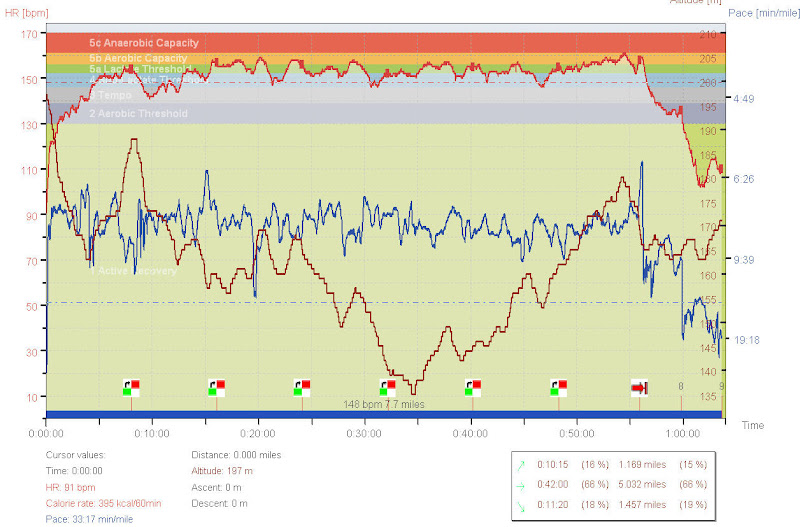
G3 graph
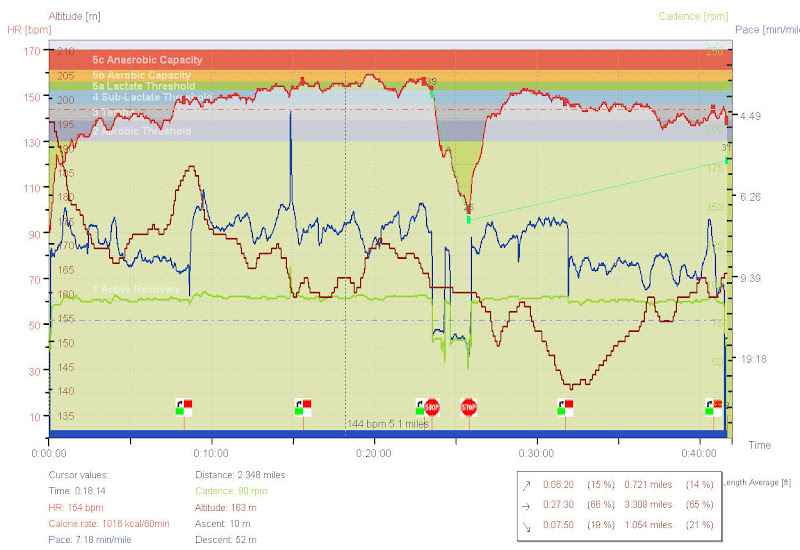
S3 graph
I used the G3 in another road race - South Mountain 10 mile road race - that I wrote about in my last post and the unit worked quite well even under fairly heavy tree cover. About 5 miles of this race is run up and down the road that is in the forrest. I did not notice any major drops in the signal coverage. You can see the picture below.
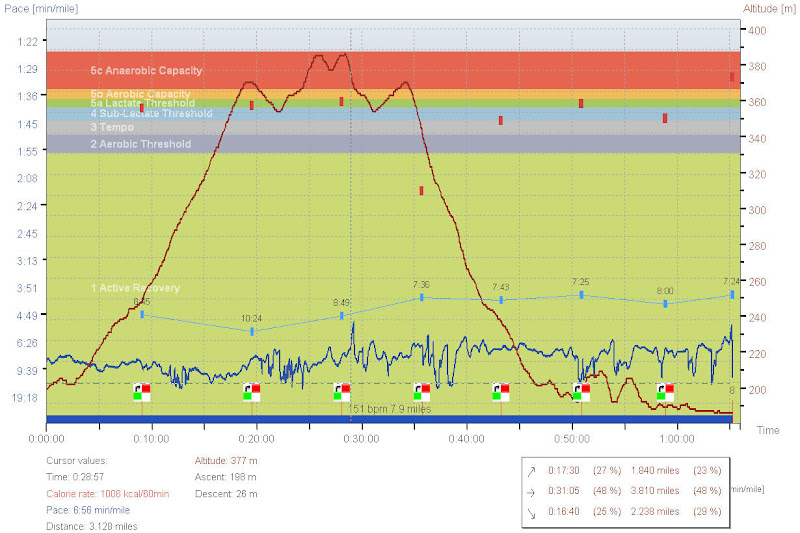
Besides running I use the G3 sensor with one of my bikes (one that does not have any gadgets like bike computer mounted on it) to get speed and distance info when I ride to the book store or just ride around the town. The G3 works very nice for the bike riding. It is very accurate in the distance reading and also in the speed reading. I'm thinking that I may use the unit next year for the triathlon racing, but I do not think I'll use it for swimming only for the bike and run legs. It will make the T2 easier as I'll not need to switch on the sensor or seek for another sensor that I had to do with the S625X and RS800sd.
Summary
If you are still puzzled whether you should get the G3 here is what it boils down to for me. The S3 and G3 sensors are very different sensors in how they work and in how they are used. If you do a lot of race track running or treadmill workouts you should stick with the S3 as you will have very little use for the G3. But if you do a lot of running outside, run trails or want to get onto the GPS train the upgrade to G3 can be a good step for you. As for what I do - I use both the S3 and G3 for my running (and biking) combining the two as I see fit. I use the S3 for all my interval and most of the tempo workouts. I use the G3 outside for either road races or long runs as well as for biking. It is nice to have the extra sensor with GPS technology I can use for biking without a need to mount the speed sensor on the bike.
 You may have heard or read about the Furman Institute of Running and Scientific Training program that has been documented on-line and also in the recently published book Runner's World Run Less, Run Faster: Become a Faster, Stronger Runner with the Revolutionary FIRST Training Program. The program is based on three weekly runs (interval session, tempo run and long run) complemented with two (or more aerobic cross training sessions). The runs are done at prescribed pace in order to achieve speed improvements, improve lactate threshold and VO2max.

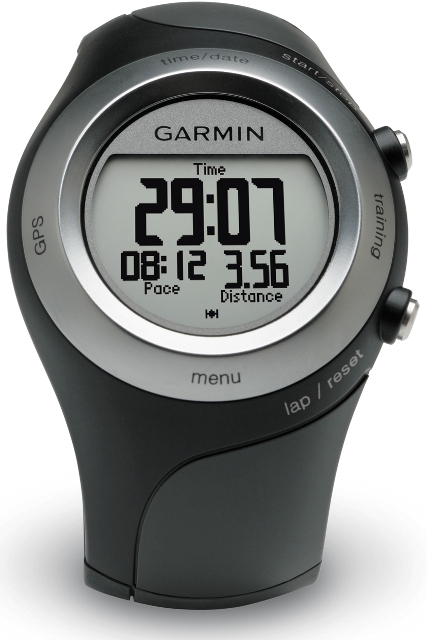 Garmin announced that they will release a new running watch in their Forerunner line. The Forerunner 405 which very much resembles the Forerunner 50 and delivers GPS technology not available in the 50. The watch will be available late in Q1 2008 - should be just around the time for the half marathon that is sponsored by Garmin. So I hope to be able to check it out at the expo. If you are interested to learn more details you can check out the
  This last week I discovered the


 Posts
Posts

