I have been sick as a dog today. My training log has a big zero for yesterday and most likely same figure for today. I found this video that Matty Reed posted on his twitter feed very motivating - it is great to see the best athletes in the sport hammer it out in Olympic distance race.
March 4, 2010


March 3, 2010
Rasmus Henning: Great athlete
In all the noise in Kona about Crowie beating Lieto by only few minutes there was one competitor that we did not hear much about although it was his first Kona and he did it while injured. Pretty amazing what Rasmus showed on the big island. I was already amazed with his performance when I saw NBC special about Ironman China where he won despite it being his first iron distance race and despite the grueling conditions. It looks like more ITU guys are making the transition to Ironman racing. We will see if that translates into faster times in Kona and other Ironman races. I definitely recommend watching the embedded video from Ironman that was recorded before Kona race last year.
March 1, 2010

February 28, 2010
Biggest week this year yet
I have not posted about my training in a while. Reasons are the usual - family, work, training and general lack of time to get to blogging. I have started using posterous this past week and hope to have better ability to post shorter updates to posterous and have them replicated to this blog.In any case this week has been the biggest TSS wise so far. I have done my longest run this year (about 400m shy of 15 miles) and some good swimming. This is the first week back in the States after spending 2 weeks in Germany. It was great to be out in Germany and do some workouts in different environment - different pool, new gym and some great running in snowy German country side on the weekend. But I must admit that I'm glad to be back home on my own bike. I no longer need to mess around with position for 20 minutes to dial it in for every session as I did on spin bike in Germany. I do not miss the free for all swimming in the pool - this particular one had sore lack of lanes and swimming through bunch of people and weaving around them was more of a challenge than a good swim. I really enjoyed swim this past Wednesday with my group where we were only two guys in the lane and knew how to share it. And the hot gyms in Europe are just plain weird - time for the designers to learn about air-conditioning. It is no fun to do 60 minutes worth of hill sprints on treadmill where temperature is like during nice summer day. Although I seem to complain about this I'm actually glad my company has a gym in Europe and that the pool was only 10 minutes away from the office and was opened until 10pm.But back to this week - it started with easy recovery after the weekend hill sprints and then slowly ramped up with swims, bike sessions and runs to long run on Saturday in which I covered some 14.75 miles with some serious hills. The first race of this season pointed out some weakness in my hill form so Craig added some more serious hill training on regular basis. This seems to help quite a bit. This Saturday's long run while I had some issues with fueling and getting water on the way I'm really happy with the performance on the hills. I attacked every single hill and took the run on purpose through some serious climbs to see how I fare. While my average pace was 8:50 for the whole run the normalized graded pace was more like 8:15 which is really good for this time of the year.Well we will see how good my hill skills are next weekend during the Quakertown 10 miler which is a great race near my home that takes place over some nicely rolling terrain and sports some good climbs. Should be fun. I wonder whether I can beat my last year's time.
January 3, 2010
First Night 5k Bethlehem PA
I first though that my last run was the Christmas City Classic 5 miles, but there was another local race - the First Night 5k I decided to jump into. Mostly because pretty good number of endurance multisport club were racing. So I took it as opportunity to see few friends before the year is over. The race is a 5k loop in Bethlehem that starts at the ice skate center in downtown and loops over the river, to Main street, down to the river, over to Sand Island for little loop and then back over the bridge to the ice skate center. Fun part about the race was that we got about 2 inches of fresh snow that morning and while it turned into slushy paddles in most areas there were spots where it was still snow that was quite slippery especially in my Newtons.
This was second run race I ran mostly by feel and looked at my watch only I think two or three times in the entire race. I ran at the pace that felt hard enough for 5k, but paid attention on the snowy patches and slowed down to almost walk as the grip in Newtons is virtually non-existent. Still I felt like I put pretty good effort and deserved all the goodness we had later in the day - all the good meats, wine and cookies.
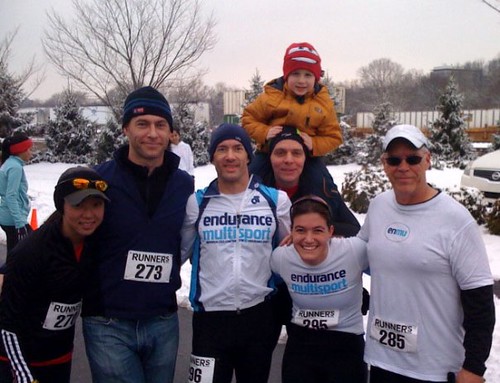
Below is picture of the endurance multisport crew that ran the race - Jes finished second overall and Andrew has shiny new PR and he ran the race in jeans (did not plan on running it, but changed his mind at the last minute). So with this picture I wish all my club peeps great 2010 season.
What's new in WKO+ 3.0
I thought that instead of writing about my summary of 2009 and plans for 2010 I'll do something else - write about something that literally made my day in few weeks ago in 2009. I was on business trip in Europe and while running from one meeting to another I got call that my other meeting was cancelled so I sat down in one of the many coffee corners we have in that office and checked my mail. To my surprise I had new mail from TrainingPeaks that new release of WKO+ was available. Knowing that I have only few minutes I quickly checked release notes and after finding about new features I purchased upgrade and downloaded the update file. Later in the day when I was done with work I performed the upgrade and started reviewing the new features. By the way the upgrade was easy and took only about 20 minutes including migration of all my training history from past 3 years. The software itself looks very good, but I had very little time while on business trip so I postponed more detailed review until I get back home.
When I got back few days later I found invite to free WKO+ seminar led by Hunter Allen that was very helpful in helping me understand how to use the software for further analysis of the workouts. The most important enhancements in my mind are the multi-file/range analysis, scatter graphs and quadrant analysis for power files. For the end user the interface seems little cleaner and the seamless integration with TrainingPeaks logging software is a welcome enhancement - not only you can upload data to TrainingPeaks.com account, but if you load data directly to web you can download them back to WKO+. This is useful when you are on trip and do not have WKO+ available to you which happens quite often to me when I go on vacation. And last but not least enhancement is the flexible licensing that let's you use your copy of WKO+ on up to two machines - great for users that have one copy on their work computer and one on home PC or laptop.
While I like all of these features I really use the multi-range analysis and scatter graph for my run and bike workouts. I use quadrant analysis for my power files as well. Great is that you can look at scatter graph or quadrant analysis inside multi-range analysis - more about that later.
Let me demonstrate the multi-range analysis on two examples - first one is training run where after warm-up you do 10 times 30 seconds on / 1 minute off intervals where the on interval is very fast running and the 1 minute is rest jog. Purpose of this session is to work on running form that you can measure by achieved average speed and average cadence in the 'on' intervals. Once I loaded the log file to WKO+ I selected all the 'on' intervals and created multi-range analysis out of it that looks something like this.
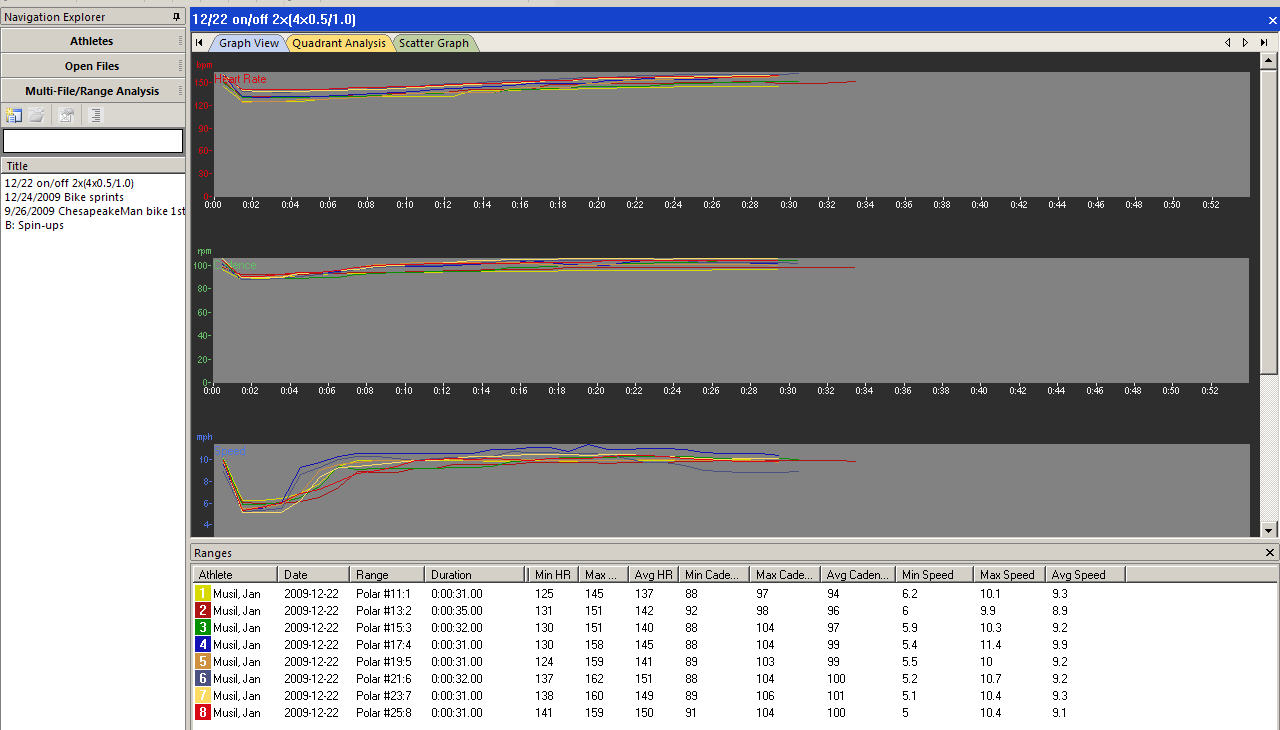
Each variable like HR, cadence, speed is plotted in separate graph and each range has different color. Once you have the multi-range analysis in place you can use the bottom part of the screen to sort the ranges by different variables - like average speed or average cadence. From the analysis you can see that the first interval was pretty fast, but the fourth was fastest while my average cadence was pretty slow on the first one (94) and gradually improved over the subsequent intervals. The detail for cadence is below.

And detail for speed follows:

In similar fashion you can analyze longer sessions or different sessions performed on different days - like comparing your speed / pace / cadence in your tempo run or track workout. This is very useful and provides great insight into how you performed in the workout.
Now let's look at another example - this one if from ChesapeakeMan AquaVelo - well the velo part of the race - e.g. 112 miles of biking that consisted of two loops (second one being shorter). I setup multi-range analysis for the loops to evaluate how well I paced the race - e.g. did I die towards the end or was I able to keep about the same power through out the race. Were there major spikes and how did I generate the power. All these questions can be answered quite easily with WKO+. Let's look at few of the graphs from this multi-range analysis.
The first picture shows the multi-range analysis where the first loop is in yellow and second loop in red. From the power ranges below the graps you can see that pacing was pretty good - +/-5 watts in power and +/-3 watts in normalized power. That is what I was aiming for.

Now let's look at how I generated that power - this is what quadrant analysis can help with. The quadrant analysis basically graphs how fast your pedal moves vs. average effective force applied to pedal (as calculated by the software). With this graph you can see how you generated the power you were putting out - e.g. fast spinning vs. mashing pedals. Here is how TrainingPeaks designed the quadrants in the software - QI: High Force and High Cadence - An example of this would be sprinting; QII: High Force and Low Cadence - An example would be steep hill repeats, big gear intervals and a lot of Mt. Biking resides in QII as well; QIII: Low Force and Low Cadence - An example would be a recovery ride or just an easy ride around town; QIV: Low Force and High Cadence - An example would be a Criterium or fast pedaling drills. The following two graphs show the two loops with the power data brought to foreground for first loop and then second loop - next to each quadrant indicator you can see average % of all power for the whole ride and for the selected range.


If you look at the two pictures above (you may actually need to go to pull the image on your desktop or enlarge it in your browser to see the detail) the power is mostly generated in QIV - low force high cadence and QII low force low cadence (read as below 90 rpm, but if you look closely the cadence is not all that low). I did some work in big gear against the wind on both loops that show in QII. It is interesting to look at the ride in this format and look not only at how well I stayed in the planned power ranges, but also consider how I generated the power.
These are the features that I started using right away and continue to use them in my training analysis. If you want to learn more I suggest to review replay of the seminar about WKO+ that you can find here. Or review information about WKO+ on TrainingPeaks.com.
December 28, 2009
One day I'll be here
This is on my list of cool races - Norseman Tri. I hope to make it here before I hit 40 - or in the year I hit 40. Looks like a very challenging race.

Subscribe to:
Posts (Atom)


 Posts
Posts

